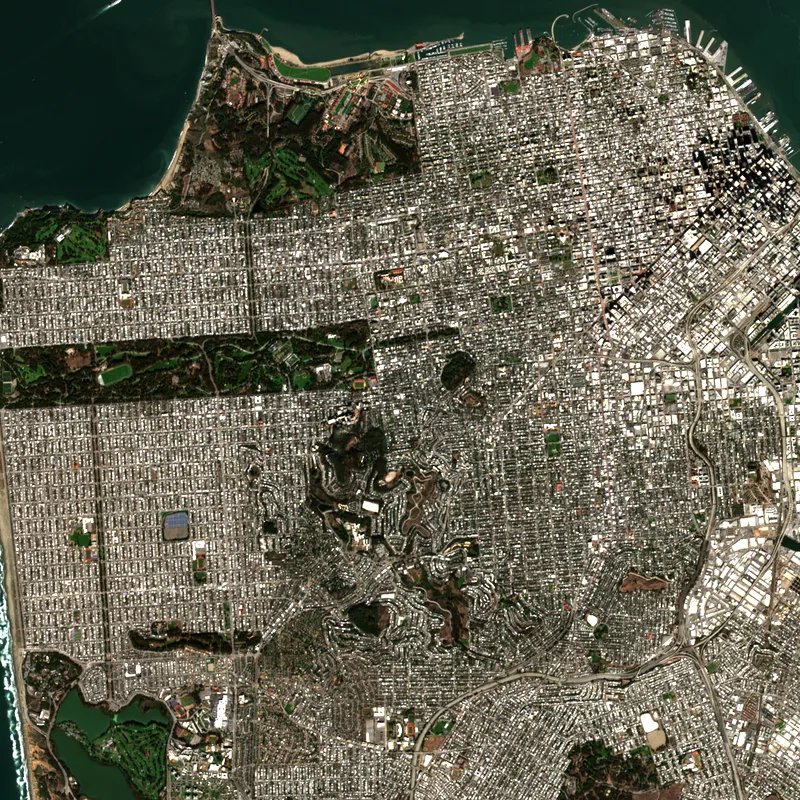
The place: the print
The town of the hospital or birth centre, or the street you brought them home to. Sentinel-2 or Landsat photographed it in their birth month; we frame the clearest pass.
10 m per pixel: the neighbourhood, not the building.
A new baby gift from space
Very probably, from that day or within a few days of it. Sentinel-2 photographs almost all land every few days at 10 metres per pixel, so the town your baby was born in was photographed in their birth month. We frame the clearest pass and print the exact date when it fell on the birthday. NASA's EPIC camera also photographs the whole sunlit Earth most days, so you can usually see the planet on the day they arrived. For a birth this week, the clearest pass may still be to come.
Welcome to the world, Ada
San Francisco
October 17, 2025
37.7749° N, 122.4194° W
Two photographs of the day they arrived
Most baby keepsakes record numbers: a weight, a length, a time. These record the day itself, from 786 km and from 1.5 million km away.
The town of the hospital or birth centre, or the street you brought them home to. Sentinel-2 or Landsat photographed it in their birth month; we frame the clearest pass.
10 m per pixel: the neighbourhood, not the building.
NASA's EPIC camera photographs the whole sunlit planet several times a day. For a baby born from 13 June 2015 on, the photo from their birthday very probably exists, and we can add it.
Free to view below, straight from NASA's archive.
From NASA's public archive. NASA usually publishes a day's photos a day or two later, so a baby born today or yesterday may have to wait.
For a baby born today
A satellite passes over each place every few days, and clouds hide some of those passes. We only ever choose from passes in the birth month, never a different month without asking, and passes later in that month count too. So for a very recent birth:
Waiting is no hardship for a gift: many people give it at the naming day or the first birthday, by which time every pass from the birth month is in the archive.
One month, illustrated
The day you arrived
San Francisco
October 2025
37.7749° N, 122.4194° W
For the nursery wall
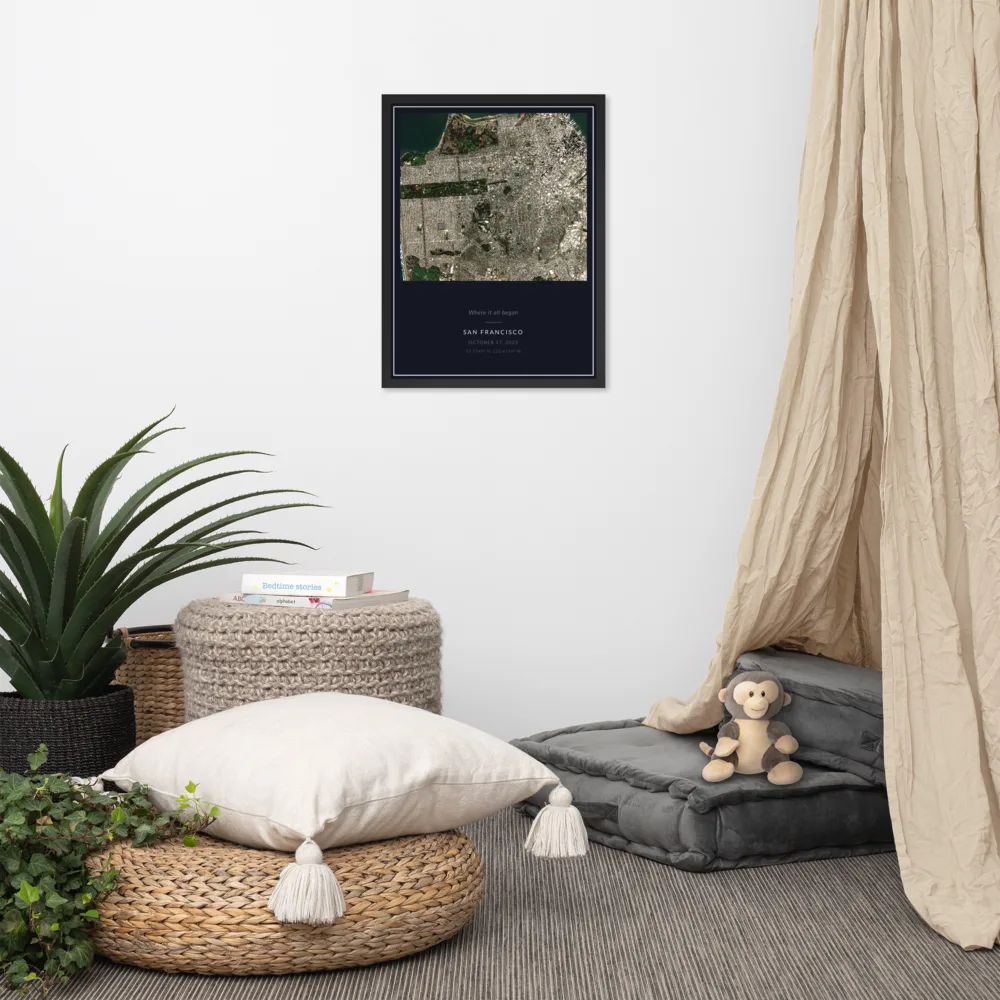
Under the photograph, the print has four lines of text, set in light, widely spaced Lato like a star chart's legend.
Message lines people might write:
There are no separate fields for weight or length. If a full list of birth stats is what you want, a birth announcement print does that better, and the two hang well side by side.
| 12×16 in · $69 | A shelf, a dresser or a small wall beside the changing table. |
|---|---|
| 18×24 in · $99 | The usual nursery size, one print on its own wall. |
| 24×36 in · $149 | A large wall, or a hallway the whole family passes. |
Luster photo paper, 260 g/m², black wood frame, acrylic front rather than glass. Wherever it hangs, keep frames out of reach of the cot.
Who gives it, and when
A push present that is about the day rather than a diamond: the place your family began, from orbit, with a line only you two would write.
The town their grandchild was born in, which they may not have seen yet. A small 12×16 travels well.
The birth month's clearest pass over where they were born, or the town of the ceremony on the ceremony day. By then the birth month is complete.
A first birthday keepsake that looks back a year: the day they arrived. Or the same town on the first birthday itself, for a pair you add to each year.
Before the birth there is no date to print. Promise it in the card and order once they arrive, or choose the day the parents moved into the home the baby will come back to.
A digital download keeps the full-resolution file. Print it again for a teenage bedroom, or give it on an eighteenth birthday with a print of the day they were born.
Other newborn keepsakes
All of these are good gifts. Which is best depends on what you want to remember. The longer version is our guide to newborn keepsake gifts for the day they were born.
| Keepsake | What it records | Better when |
|---|---|---|
| Birth stats print | Name, weight, length, time | You want the numbers on the wall |
| Star map of the night | The sky as calculated for the time and place | They were born at night, or you love the sky |
| Newspaper from the day | What the world was talking about | It is a gift for when they are older |
| Time capsule | Whatever the family chooses to keep | You want letters and objects, opened later |
| Satellite photo | The real place, photographed from orbit that month | The place matters as much as the date |
Ways to give it
The snow globe is coming soon.
Very probably one from that day or within a few days of it. Sentinel-2 photographs almost all land every few days at 10 metres per pixel. Clouds hide some passes, so we choose the clearest pass from the birth month and print the exact date only when the pass fell on the birthday. Otherwise the print shows the month and year.
Yes. You see the actual photograph and its capture date before you pay. If the passes so far were cloudy, you can wait: any clear pass later in the same calendar month can be used, so by the end of the month there is more to choose from. New passes usually reach the public archive within a few days.
No. At 10 metres per pixel you see the neighbourhood: streets, parks, rivers and the coast, but not a single building. The coordinates line on the print marks the exact spot you chose, such as the hospital or your front door.
The print has one line for your own words, up to 60 characters, above the place name, the date and the coordinates. A name and a time fit easily, for example "Ada, 7:42 in the morning". There are no separate fields for weight or length, so a full birth-stats list fits better on a birth announcement print.
For a baby born after 13 June 2015, very probably. NASA's EPIC camera photographs the whole sunlit Earth several times a day and publishes the photos free, usually a day or two later. There are occasional gaps. You can look up any date on this page.
Not on its own, because there is no birth date to print yet. At a baby shower, write the promise in a card and order once the baby has arrived, or choose a different date, such as the day the parents moved into the home the baby will come back to.
Start from the whole Earth and fly down to the place they were born.
Begin the descent